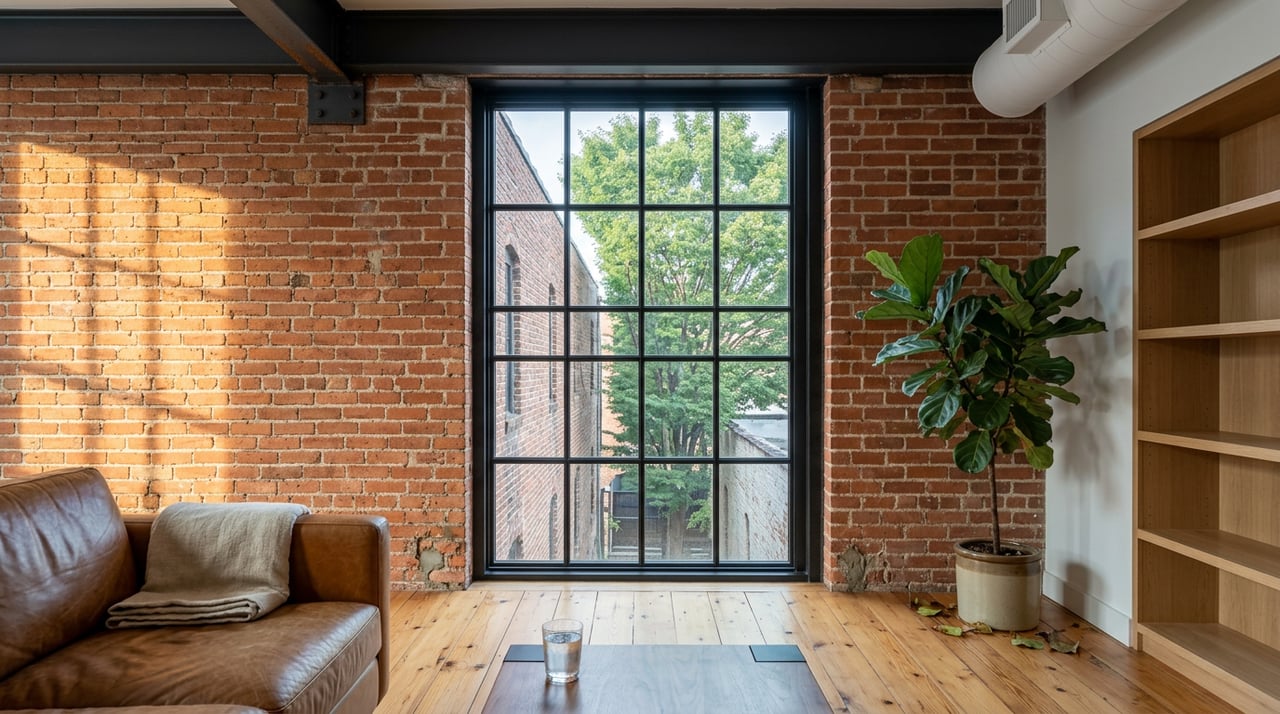
Walk into the Arras Building in downtown Asheville and ask about renting your unit on Airbnb, and the answer depends entirely on which floor you're standing on. The short-term rental program there is permitted on the tenth floor only. A buyer looking at an identical unit one floor down is looking at a completely different property in every way that matters financially, even though the square footage, the finishes, and the view are the same.
If you've been watching downtown Asheville's numbers on the portals and come away confused, this is why. The neighborhood's median price data looks like it's telling a story about decline. It isn't. It's telling a story about a market that got split in two by a City Council vote nearly a decade ago, and a headline number too thin to notice the split.
What the scary number actually measures
As of March 2026, Redfin's downtown Asheville figures show a median sale price of $500,000, down 36.1% from the same month a year earlier, with homes taking an average of 167 days to sell compared to 73 days the year before. That reads like a neighborhood in freefall.
Here's the detail that changes the picture: those numbers come from eight closed sales for the month, down from ten the year before. With a sample that thin, one or two high-end units closing in a different month than usual can swing the median by six figures without a single seller actually changing their price.
You can see the same instability from the other direction. A separate February 2026 snapshot of downtown condos alone puts the median home price at $859,000 with an average sale price of $742,961, and condos spending an average of 110 days on market, not 167. Two data pulls, one month apart, on overlapping inventory, and the median swings by more than $300,000. That's not two different markets disagreeing about value. That's what happens when a small number of transactions gets treated like a trend line.
The mechanism underneath the noise
The real structure worth understanding predates any of this year's swings. In January 2018, Asheville City Council voted 6-1 to expand restrictions on short-term vacation rentals from residential neighborhoods into commercial and mixed-use districts, including the areas covered by the River Arts District and Haywood Road form-based codes. The vote left one meaningful exception standing: whole-unit vacation rentals remained largely permitted in the Central Business District, the zoning designation that covers downtown proper, bounded by the Beaucatcher Cut to the east and I-240 to the north and west.
Any unit that was legally operating as a short-term rental before that vote could keep its permit under grandfathered, nonconforming status. Everything built or converted after didn't get that option unless it sat inside the narrow footprint still zoned for it. By the time planning staff reported back to Council that December, 63 units in the Central Business District had already converted from residential to lodging use since 2015. Zoning Administrator Shannon Tuch told Council that in the weeks after that report alone, the city had received applications for 53 more.
That's the mechanism. Downtown Asheville doesn't have one condo market. It has a market for units that can legally host a guest for three nights, and a market for units that can't, sitting in the same buildings, subject to the same HOA dues, and worth meaningfully different amounts to a buyer weighing the numbers.
Where you can see it in the listings
You don't have to take the Arras Building as an isolated case. Walk the rest of the active listings and the same split shows up in the marketing copy. A unit at 45 Asheland sells itself on the fact that its short-term rental permit conveys with the sale, language a listing agent would never bother including if every unit in the building had the same right. One23 Haywood, built by Copper Builders, markets the flexibility of optional short-term rentals as a headline feature, not a footnote. And when The Churchill broke ground in January 2026 as downtown's first ultra-luxury condominium project, its concierge-and-amenity pitch leaned on that same flexible ownership, proof that the permit question follows new construction downtown just as much as it follows older buildings.
None of that is universal to the neighborhood. It's building-specific, sometimes floor-specific. Which means neighborhood-level comps are close to useless for pricing a downtown condo. The comp that matters is the other unit in the same building with the same permit status, not the median for "downtown Asheville."
Even the zip code line is misleading if you zoom out. In March 2026, the 28801 zip code, which covers the downtown core, carried a median listing price around $800,000, while 28806 on the west side of the river sat closer to $475,000. Two zip codes a few minutes apart, both technically part of greater Asheville, telling almost opposite stories depending on which one a headline picks.
The Helene perception gap nobody's numbers capture
There's a second reason downtown's story gets misread, and it has nothing to do with permits. When Hurricane Helene hit in September 2024, the French Broad and Swannanoa Rivers did the damage, and the neighborhoods that sit closest to those rivers took the worst of it. The River Arts District and Biltmore Village were badly flooded and remained largely closed for months afterward. Downtown proper, sitting on higher ground away from the riverbanks, came through largely unscathed and was back up and running within weeks.
That distinction hasn't fully caught up with public perception. As one Asheville Chamber of Commerce leader put it, downtown still fights the assumption among visitors who saw flood footage that the whole city was affected, even though the business district itself was in much better shape than the hardest-hit areas. The Asheville Downtown Association's own foot traffic data tells the opposite story from what a worried buyer might expect: the district averaged 51,600 daily visits from December 26 through 31, 2025, up 42% from the 36,400 daily average earlier that month, with December 28 becoming the strongest single day South Slope had all year, ahead of even its July Fourth block party.
A buyer scanning headlines about Asheville's recovery might discount downtown along with the neighborhoods that actually flooded. The data on the ground doesn't support that discount. It's one more way the raw numbers and the real conditions on the street have drifted apart.
What this means before you write an offer
If you're comparing downtown Asheville to other neighborhoods on price alone, you're comparing an average of two products that don't behave the same way. Before you anchor to any number, a few things are worth confirming on the specific unit, not the neighborhood:
- Does the short-term rental permit, if one exists, actually convey with the sale, or is it tied to the current owner
- What floor or unit range within the building the permit covers, since it's often not building-wide
- Whether the HOA's own covenants restrict rentals further than the city does, since an association can be stricter than zoning even where the city allows it
- Whether the building was constructed or converted before or after January 2018, which determines whether grandfathering is even possible
A few questions worth asking
Does a lower median price mean downtown condos are cheaper right now than they look elsewhere? Not necessarily. The $500,000 March 2026 median and the $859,000 February 2026 median both describe overlapping downtown inventory in the same season. The gap says more about small sample sizes than about value. Price against the specific building and permit status, not the headline.
Can I apply for a new short-term rental permit if my unit doesn't have one? It depends on where the building sits. Outside the Central Business District, a new whole-unit permit is effectively unavailable unless the property qualifies as grandfathered from before January 2018. Inside the CBD, a unit can still apply for its own permit, which is why newer downtown buildings can market rental flexibility even though a comparable condo a few blocks away in a residential zone can't. Either way, if you plan to live in the home yourself and rent out a room or two, the city's homestay program is the more accessible path and comes with its own separate permit process.
Is downtown Asheville at the same flood risk as the River Arts District? They sit in different terrain. The River Arts District and Biltmore Village are close to the French Broad and Swannanoa Rivers and took the brunt of Hurricane Helene's flooding in 2024. Downtown proper is on higher ground and came through that storm largely undamaged. Past outcomes aren't a guarantee about future events, but they're a meaningful difference worth knowing when you're weighing neighborhoods.
Downtown Asheville's price data will keep looking erratic as long as so few units close in any given month and so much depends on a permit most buyers never think to ask about. If you're trying to make sense of a specific building or a specific unit rather than a headline median, that's exactly the kind of ground-level read TFM Carolina spends its days working through with buyers. Get Started when you're ready to look at the actual comps instead of the average.