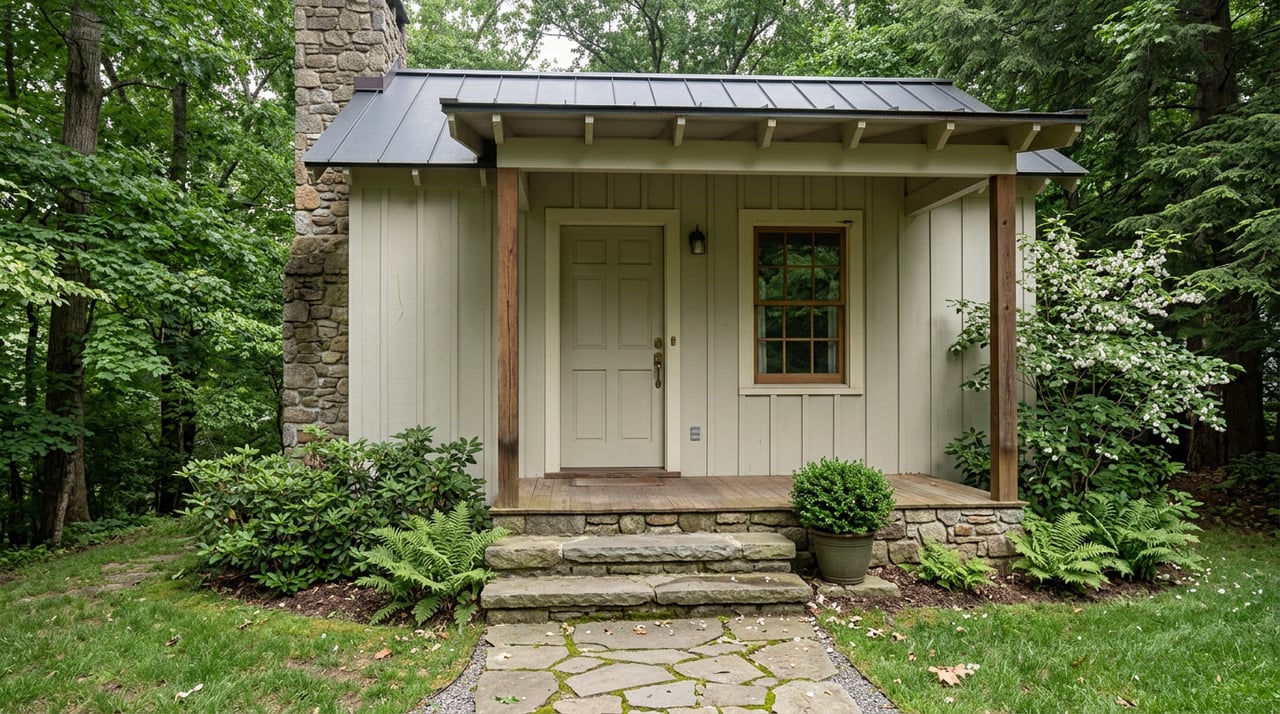
Pull up two active listings in East Asheville right now. One is a single-room log cottage built in the early 1930s, under 500 square feet, with a mini-split for heat and a rental history already attached. The other is a wooded parcel of twenty-plus acres a few minutes away, marketed as raw material for a family compound. Both sit inside the same neighborhood boundary. Both would show up if you searched "homes for sale, East Asheville." And neither one looks anything like the median price you'd find if you typed that search into a portal.
That's the problem with treating East Asheville as a single market. It isn't one. It's two housing stocks that happen to share a ZIP code, a school district, and very little else, and the blended number that gets reported as "the median" describes neither of them accurately. If you're comparing neighborhoods right now and East Asheville is on your list, the median is the least useful number you'll look at this week.
What the median is actually measuring
As of August 2026, the median sale price across all of East Asheville sits at $399,000, with an average sale price of $439,307 and homes spending roughly 76 days on the market before going under contract. Look at the trailing twelve months instead and the median comes in at $395,000, a 13 percent jump from the year before.
Now narrow the view to Haw Creek, the valley that makes up the largest and most established chunk of East Asheville's housing stock. Over the same trailing twelve months, Haw Creek's median sale price was $543,500, up 7 percent year over year, with homes selling in an average of 42 days.
That's a gap of roughly $145,000 between the neighborhood-wide figure and its own largest sub-market. And Haw Creek's homes are also moving almost twice as fast, 42 days against 76. Something is dragging the broader East Asheville number down and slowing it down at the same time, and it isn't a mystery once you know where to look.
The figure folds conventional homes together with rental-oriented cottages, two products that were never competing for the same buyer.
The cabins that started as a summer resort
Drive to the intersection of Tunnel Road and Swannanoa River Road, near where the WNC Nature Center sits today, and you'll find a cluster of small log cottages tucked onto narrow lanes. This is Homeland Park, and it wasn't built as a residential neighborhood at all. Between 1928 and 1932, Eugene Hester and Roland Wilson assembled the land and incorporated Homeland Tourist Park, one of the region's early tourist courts. They built the first ten cabins in 1932 and advertised as far as Phoenix, Denver, and Los Angeles. By 1936 the resort had grown to 60 cottages across roughly 45 acres, eventually reaching about 65, complete with its own 200-seat restaurant, gift shop, and steam heat piped underground to the cabins.
The construction is distinctive even by mountain-cabin standards. The logs are whole and stripped rather than hewn, the ends aren't notched, and most cabins still carry their original fieldstone fireplaces and heart-pine floors. By the 1950s, Asheville's growth had surrounded what was once a remote resort, and the cabins gradually converted from vacation rentals into year-round residences.
That history matters for anyone shopping East Asheville today because it explains what you're actually buying if a Homeland Park cottage catches your eye. These are not scaled-down versions of a typical single-family home. Many run under 500 square feet with one bedroom and one bath, a kitchenette instead of a full kitchen, and a mini-split rather than central HVAC. Several current listings are explicitly packaged as furnished, turn-key rentals with income history attached rather than as primary residences. That's a different transaction than a standard mortgage purchase, and it comes with its own friction: lenders and appraisers built around comparable sales can struggle to find true comps for a sub-500-square-foot cottage sitting a few streets away from four-bedroom homes on an acre. If you're financing rather than paying cash, ask your lender early whether the property qualifies for a conventional loan or whether you're looking at a different financing path entirely.
The valley that never stopped growing
Haw Creek is the other half of the story, and it couldn't be built more differently. The valley runs from US 70 and Tunnel Road at I-240 out to Groce Methodist Church, bordered by Piney Mountain and Bear Mountain to the west, Town Mountain and Peach Knob to the north, and Bull Mountain to the east, with Riceville sitting just beyond it. Inside that footprint you'll find 1960s ranch homes on creekside lots, new mountain-contemporary construction with vaulted ceilings and walls of glass, planned communities like Hawthorne Villages and Sondley Estates, and townhome clusters like Dillingham Woods.
At the far end of the spectrum, Haw Creek is also where East Asheville's acreage plays live. Current inventory has included a 20-plus-acre tract marketed for a private estate or family compound, and a separate two-parcel offering totaling 3.72 acres pitched the same way. One listing described a property backing directly onto Blue Ridge Parkway land with its own access point to the Mountains-to-Sea Trail. This is buildable, usable acreage close to downtown, which is a combination that's become harder to find across Buncombe County generally.
The neighborhood has its own gathering points too. Haw Creek Park offers paved and unpaved trails along with a playground and basketball court. Masters Park connects hikers directly to the Blue Ridge Parkway and the Mountains-to-Sea Trail. Charlie Bullman Park's six acres of athletic fields sit next to the East Asheville Rec Club, which runs a community pool and tennis courts. A small commercial cluster along the way includes Penny Cup Coffee, Creekside Taphouse, and The Whale Bottle Shop.
That range of housing stock, from a 1960s ranch to a 20-acre building site, is exactly why Haw Creek's own median sits so far above the East Asheville median, and why its homes sell so much faster. It's a more conventional market with a deeper pool of comparable buyers at every price point, which is the opposite of what's happening in the tiny-cabin cluster a few miles away.
What this means before you write an offer
If you're comparing East Asheville to other neighborhoods on your list, the first question isn't what the median is. It's which East Asheville you're actually looking at.
A few things worth sorting out with your agent before you get attached to a number:
- Ask whether the comps being used for a specific listing are drawn from the immediate cluster (Homeland Park, a planned community like Hawthorne Villages) or from the wider East Asheville pool, since blending the two will distort your sense of fair value in either direction.
- If you're looking at a cottage-scale property, confirm upfront whether it will appraise as a standard residential purchase or whether you're better served treating it as a cash or investment-property transaction.
- If acreage is the goal, get a sense of buildable versus wooded terrain before you price the land, since a 20-acre listing description doesn't tell you how much of it can actually hold a foundation.
- Use days on market as a signal, not just price. Haw Creek's 42-day average points to steady, competitive demand for its housing stock, while the wider East Asheville figure of 76 days is being stretched by a smaller pool of buyers who specifically want what Homeland Park offers.
None of this makes East Asheville a harder place to buy. It makes it a neighborhood where the headline number is doing you a disservice, and where a little local specificity turns a confusing search into a clear decision.
A few questions worth asking
Is a Homeland Park cottage a realistic primary residence, or mainly an investment property? Both, depending on the buyer. Some residents have lived there full time for years, and the community has a long history of year-round occupancy going back to the 1950s. Others are buying specifically for the rental income history that comes with several current listings. Worth clarifying which path you're on before you make an offer, since it changes your financing and your expectations for square footage.
Does Haw Creek have an HOA? It depends entirely on which pocket you're looking at. Older sections and standalone homes largely don't, while planned communities like Hawthorne Villages and Sondley Estates typically do. Ask specifically about the parcel you're considering rather than assuming one answer covers the whole valley.
If I want acreage, is East Asheville still a realistic option? Yes, though the inventory is thinner than it used to be. Haw Creek has produced multiple double-digit-acreage listings recently, including tracts pitched for family compounds and legacy properties. These tend to move as land value plays first and house value second, so pricing them requires a different lens than pricing a finished home.
If you're weighing East Asheville against other neighborhoods and want a clearer read on which pocket actually fits what you're trying to buy or sell, TFM Carolina can walk through the comps that matter for your specific property, not the blended average that shows up on a portal search.
This article is general information, not legal, tax or financial advice. Consult a qualified professional about your situation.